Truyền thông
WHICH IS BETTER: ISLAND BIRD'S NEST OR HOUSE BIRD'S NEST? A DETAILED ANALYSIS 2023

Besides natural bird’s nests harvested from islands, more and more swiftlet houses have been established. This has led consumers to wonder: Which is better, island bird’s nest or house bird’s nest? In this article, we will examine the differences between island and house bird’s nests to help you make the right choice.
First, we need to distinguish that in Vietnam there are two types of swiftlets whose nests can be harvested and consumed for health benefits:
These two species can be differentiated by feather color, tail span, wing span, etc. House swiftlet (Amechanus): dark-colored feathers, wingspan about 114 mm, beak length 3.7 mm, tail length 49 mm, legs about 10.3 mm, and body weight around 12.6 g. Island swiftlet (Germani): heavier, weighing about 13.9–14.5 g, with pale white feathers.
Island bird’s nest, also called natural bird’s nest, is harvested from swiftlets living in caves and cliffs under favorable natural conditions. In Vietnam, bird’s nests from Khánh Hòa province account for 60% of the country’s natural bird’s nest production.
The diet of island swiftlets comes entirely from nature, including insects, flying ants, termites, flies, and mosquitoes. They usually forage in the morning and return to their nests in the evening. Island swiftlets molt and reproduce twice a year, in April and October.
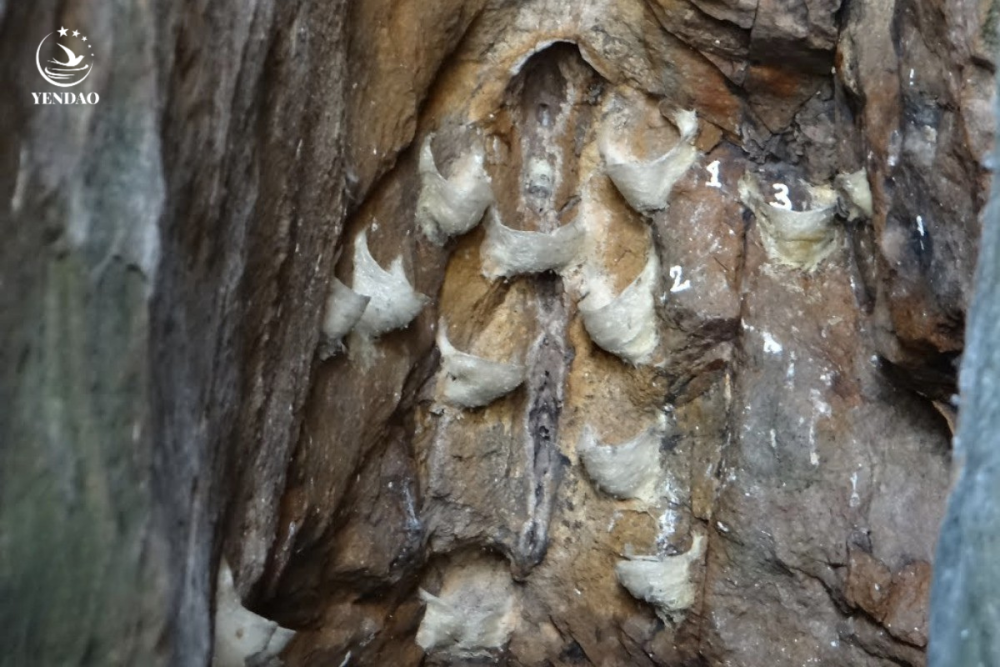
The natural environment of caves is typically very humid, making it difficult for swiftlet nests to cling to surfaces. As a result, the base of the nest is usually large and firm to anchor securely onto the rock walls. The body of a natural bird’s nest is also thick, tightly interwoven, forming a cup-like shape that protects the eggs and chicks from weather conditions and predators.
Because the nests are built on rock walls, natural bird’s nests contain many trace elements such as iron, zinc, and calcium. During the nest-building process, swiftlets are exposed to various environmental factors that promote organic fermentation, giving the nests distinctive colors and abundant nutritional value. However, it is unavoidable that some nests may also contain elements unsuitable for humans, such as nitrate, nitrite oxide, etc.
According to the experience of harvesters, the deeper the nests are located inside the cave, the redder they become (commonly known as blood nests). Nests near the cave entrance usually have an ivory-white color (called white nests). Slightly deeper inside the cave, the nests take on an orange-brown shade (known as pink nests). Because harvesting requires facing many risks, island bird’s nests are considered premium products, highly sought after by consumers.
House bird’s nests are mainly found from Đà Nẵng southward. They are harvested from swiftlets raised in specially designed houses. These houses are professionally built to replicate natural conditions, with controlled temperatures that allow swiftlets to grow normally. The nutritional composition of house bird’s nests is not significantly different from island nests, but they are considered safer and more suitable for all types of consumers.

House swiftlets usually build their nests on concrete ceilings and wooden beams, so the base of the nest is smaller and thinner compared to island nests. They reproduce year-round, with certain months showing higher breeding rates than others. Their reproductive cycle lasts about 3–4 months.
House bird’s nests are only ivory white in color, and their quality depends on the food sources the birds find daily. Importantly, house nests provide higher health safety thanks to the ability to control environmental conditions.
The differences between island and house bird’s nests can be categorized as follows:
Island nests: Range from white, light orange, to deep red (blood nests). House nests: Ivory white, more common in the market. They have a characteristic fishy smell, but lighter than island nests due to less exposure to weather and climate factors.
Island nests: Larger, thicker, and tightly interwoven. Their surface is rough, with stronger fibers. The base is firm and shaped like a cup. House nests: Smaller and thinner.
Island nests: Harvesting is dangerous, requiring high costs and manpower to collect intact nests, as they are built on steep cliffs or deep caves. House nests: Easy to harvest, often requiring only a ladder or chair to collect.
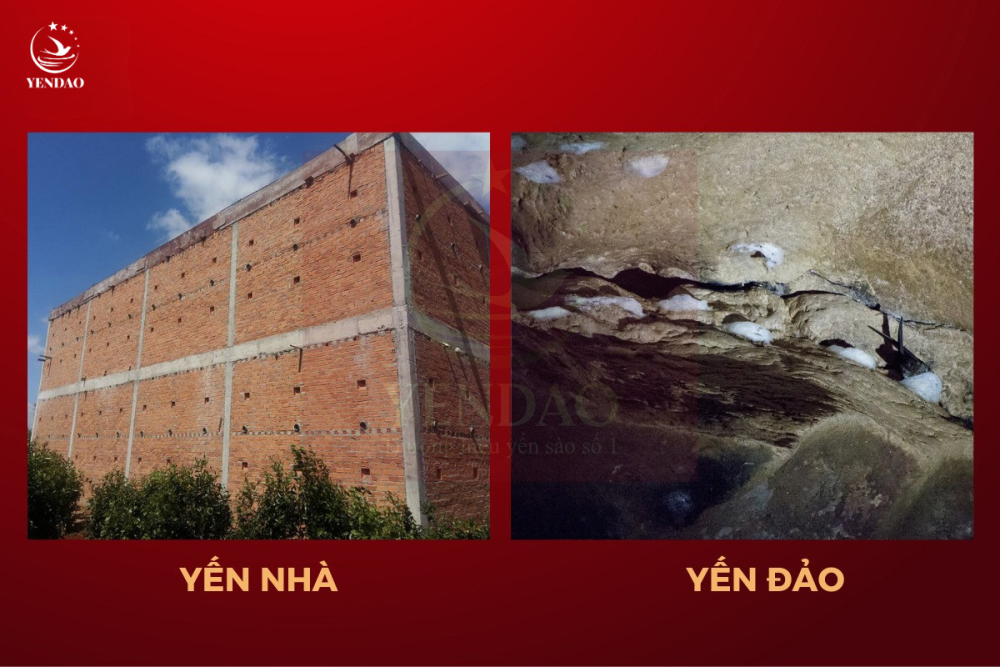
The main difference between island bird’s nests and house bird’s nests in terms of nutrition lies in the minerals found on rock walls, such as iron, zinc, and calcium, which integrate into island nests, giving them higher nutritional content compared to house nests.
Island bird’s nests are quite selective in terms of suitable users. They are not recommended for children, patients with kidney stones, or those with high blood pressure, because the natural cave environment can cause the nests to contain trace elements such as nitrate and nitrite oxide, which may negatively affect these conditions.
House bird’s nests, on the other hand, are suitable for all consumers—especially those recovering from illness, children, and pregnant women—because the breeding environment is well controlled, minimizing the impact of disease and mold. House nests are also less likely to change color, ensuring absolute safety for consumers’ health.
Currently, there are differing opinions on whether natural island nests are better than house-raised nests. Some believe that island nests are of much higher quality, as their price is significantly higher. This viewpoint may be valid, since island nests grow, develop, and are built in a unique natural environment, absorbing the essence of nature, which allows them to adapt better to their surroundings to some extent.
Others argue that the high price of island nests is mainly due to limited supply, difficult harvesting, and the great effort required to collect nests built on high cliffs. According to scientists, the nutritional composition of natural and house-raised nests does not differ significantly. Consumers can therefore choose the type that suits their needs, saves costs, and is easier to clean.
Today, many swiftlet houses apply semi-natural farming methods: the houses are built for nesting at night, while during the day the birds still forage outdoors. In the past, products such as bird’s nest and blood nest were not available from house-raised birds, but thanks to technological advances, farmers can now produce these varieties as well.
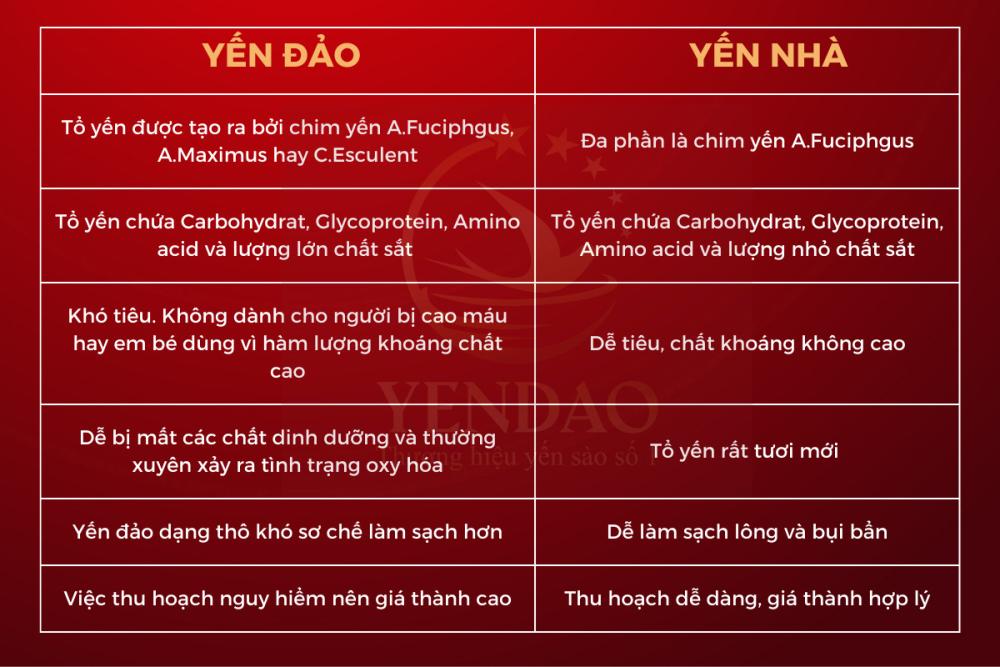
With the information just shared about the differences between island bird’s nests and house bird’s nests, you can see that it is not possible to definitively say which is better. The decision of which type to purchase depends on each consumer’s financial situation and personal needs. The most important factor to consider when buying bird’s nests is the brand and a reputable supplier to ensure your family’s health.
Yến Đảo Cần Giờ is honored to accompany every Vietnamese household on the journey of health care with 100% pure bird’s nests, free from additives or preservatives, produced under modern technology lines that meet international standards ISO 22000:2018 and HACCP, offering a wide variety of bird’s nest products to consumers. Contact us today to shop at the most economical prices!
YEN DAO CAN GIO JOINT STOCK COMPANY
Address: 170 Dao Cu Street, Phong Thanh Quarter, Can Gio Commue, Ho Chi Minh City, Vietnam.
Hotline: 1900 86 68 37
Website: https://yendaocangio.com/
Fanpage : https://www.facebook.com/YenDaoCG
Youtube : https://www.youtube.com/@yendaocangiovietnam
Email : contact@yendaocangio.com
Bài viết nổi bật

 26/10/2025
"VÀNG TRẮNG" CẦN GIỜ ĐƯỢC TÔN VINH


CÔNG TY CỔ PHẦN YẾN ĐẢO CẦN GIỜ
Trụ sở chính: 170 Đường Đào Cử, Khu phố Phong Thạnh, Xã Cần Giờ, Thành phố Hồ Chí Minh, Việt Nam
Email: contact@yendaocangio.com
Hotline: 1900 866 837
Mã số thuế: 0315675327
Mã số đăng ký kinh doanh: 0315675327
© Bản quyền thuộc về CÔNG TY CỔ PHẦN YẾN ĐẢO CẦN GIỜ